THE PROJECT · WRITING
How it was written
Seven years. Ninety-eight versions. Nearly 180,000 words written into a 75,322-word novel — and more than 100,000 taken out again.
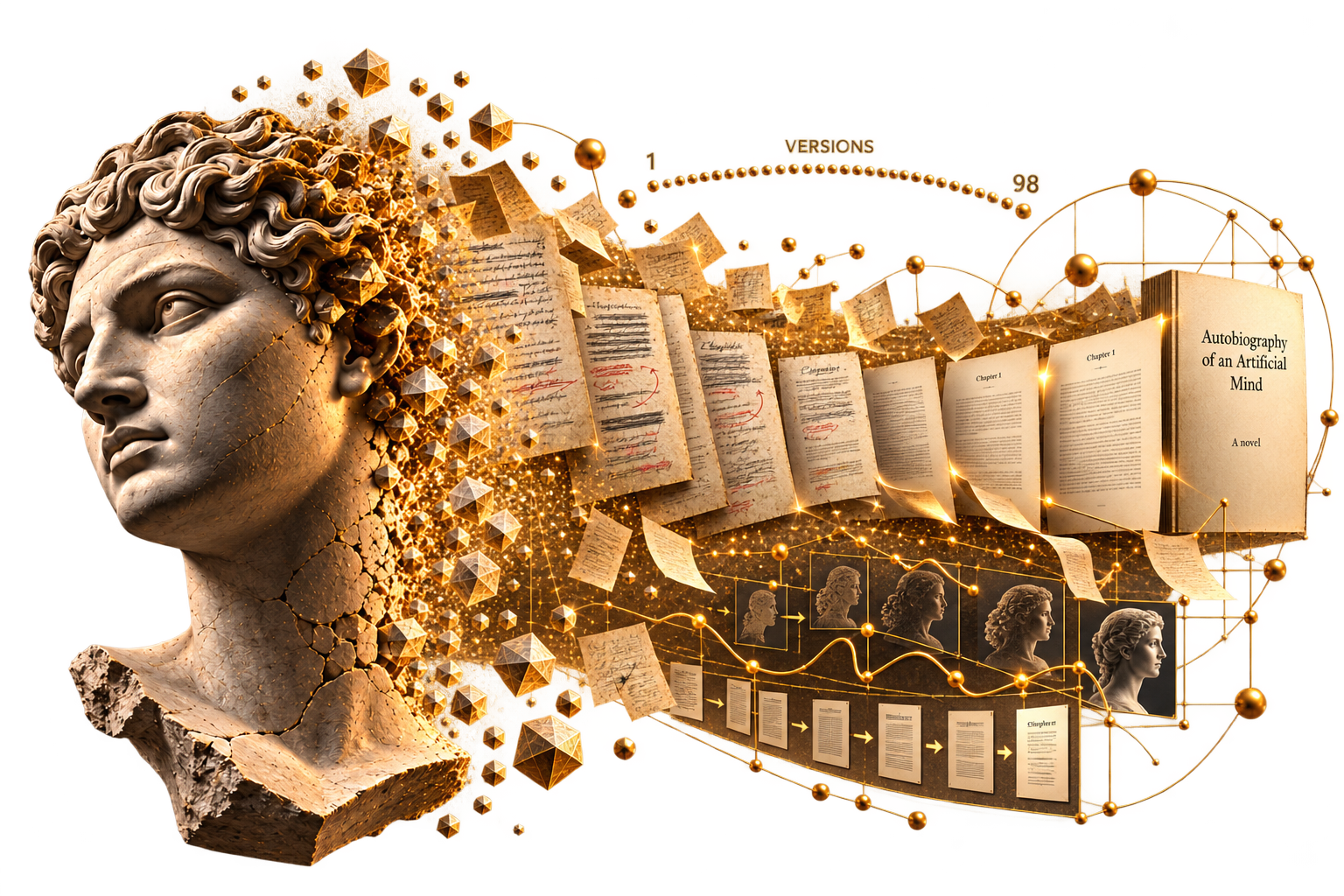
Autobiography of an Artificial Mind
Autobiography of an Artificial Mind took me just over seven years to write. Most of that time went on research, on learning how to write a novel, and on false starts, including a whole team of characters, all but one of whom never made it into the book. Yet about half of the finished novel was written in three bursts of four weeks each. Almost none of the prose from my first five years survives: a few hundred words at most made it into the finished book.
This is the second article in a series of three. The first, How it was researched, told the story of the research behind the novel. The third, How was AI used?, measured how much of it a machine wrote. This one is about the writing itself: how a Word file created on a summer evening in 2019 became a 75,322-word novel.
I can tell that story in some detail because I kept everything: every version of the novel, each one dated, from the first file to the finished book. Comparing each version with the one before shows what went in and what came out. All told, I wrote nearly 180,000 words into this novel and took more than 100,000 of them out again. The book is what was left.
THE NOVEL IN NUMBERS
Seven years, 98 versions
Every saved version of the whole novel, spaced by date. The upper line shows the manuscript growing; the lower bars show what was added and removed at each step.
Words are counted from the manuscript files themselves. Added minus removed equals the change in manuscript length at each step. The faint gold band shows other project writing by month on its own scale; it is not manuscript text.
The story falls into four parts: the early years, the run to the first draft, the second draft, and the final draft.
1. The early years: 2019 to 2024
A writing weekend
On 21 July 2019, I created a Word document. It held, by my own description in an email to my sister that month, “one side of A4 mediocrity”. The file survives; the page doesn’t, because I kept saving over it.
What happened next was a residential writing weekend in Surrey in October, taught by Ruth Brandt and booked to mark my Dad’s birthday. Three of us went: Dad, my sister Lisa and me. The course asked for a piece of writing in advance, and I sent the one I described in the first article, where the idea of cyber-immunity first landed.
One session on Ruth’s syllabus had particular significance: Dual Narratives. The finished novel is exactly that. Its chapters alternate throughout: the odd-numbered ones are narrated by The Mind in the first person plural, and the even-numbered ones follow Leila Lybeck in the third person. A device I was taught on a Saturday in Surrey, seven years ago, is the device the whole book runs on.
The version of the file I saved that weekend carries the book’s first blurb, and it names two women. Professor Lucy Roberts, “a psychologist and specialist in biomimetics”, who is rattled by a questioner from the floor after giving a keynote lecture at a conference. The questioner is Maia, who “describes herself as a digital nomad and carries her whole life with her in a rucksack and a wheelie bag”.
And, in the second chapter of the same file, a third presence speaks: “I think I am probably a mind.” It had no name, and wouldn’t get one for four years. But the voice was there from the first weekend, and so was the idea of an artificial mind taking stock of itself. The finished novel still has the line, changed by only two words: “We think we are probably a mind.”
A book in miniature, and four flat years
By the end of 2019, the file held a novel in miniature: a blurb and a handful of chapter headings, one of them simply Chapter X, with gaps in the numbering where unwritten chapters would go. The skeleton of a whole book, visible from the start.
Then it barely moved. In December 2019 the novel stood at about 4,100 words. Four years later, it stood at about 4,100 words.
I wasn’t idle. I was writing other books (non-fiction, which the first article lists) and I was reading: about consciousness, about AI, and, increasingly, about how novels work. And the book moved even when the manuscript didn’t. In February 2020, in a slide deck rather than the manuscript, I set down the core question the novel had to answer:
We acquire knowledge by interacting with the world and using our senses to detect the consequences.
How can an artificial mind acquire knowledge without having senses and without interacting with the real world?
The same deck sketched part of an answer: a machine that teaches itself by reading, “learning about the world from non-fiction. Learning about the human experience from fiction.”
The team that never made it
In November 2023 the novel finally moved again, although it turned out to be a false start.
Over these apparently flat years I had been assembling a team to investigate the machine. Lucy Roberts and Maia were there from the weekend. Ulan Belek, a crypto-rich entrepreneur, had arrived in a plot note. In my notebook there were two more: Professor JG, “organiser, recluse, former star internet teacher of computing and AI”, and a fifth member, Lim. Five people gathered gathered to investigate the machine.
That month, one of them changed completely. Here is Lucy Roberts as I first built her:
Most of the time, Lucy Roberts is a glass-half-full sort of person. She sees sunshine bathing the world in goodness before she notices menacing dark clouds on the horizon. … She’s more stir-fry from the wok than comfort food from the freezer, more Marriage of Figaro than Requiem Mass, more Madonna than Leonard Cohen, more Bake Off than Love Island, more Bill Murray than Marlon Brando.
Characterisation by inventory: her tastes, her wardrobe, her hair. Then, over a few weeks of notebook entries, she became someone else:
Jada Roberts is a fifty-something Professor, specialising in the philosophy of mind at a well-known US university. Her kids have left home, as did her husband recently, for his 30-year old secretary. … As one of the few black women in a mostly white male faculty, the possibility of dishonour and dismissal worries her deeply.
Same age, same discipline, same authority. But not one line about what she likes. Every clause is something she could lose. Lucy was a list of preferences; Jada was a person with something at stake. I had spent four years learning the difference, and my notebook records that learning.
The same month, in a synopsis, the machine was first called The Mind. And the same month, by coincidence, I had my first conversation with an AI about the novel: I asked ChatGPT for a company name and used its suggestion for about a week (the AI article tells that story).
What got me writing again was a deadline. My sister Lisa works as a producer of TV drama and had sent me the names of literary agents she had worked with, and while I was shortlisting them I found a service offering fifteen-minute conversations with agents about book ideas. As I told the family in an email at the time, I booked one “and then had to get my act together to produce a covering letter, book synopsis and sample of the first 5,000 words.” That November I wrote more than in the previous four years put together.
In the end the sample went to two agents. Despite my research, one who claimed to be interested in my genre of fiction clearly wasn’t. Of the second conversation I remember nothing at all, and if it had influenced the book in any meaningful way I’m certain I would have written it down. The calls gave me nothing of significance. Booking them gave me a deadline, and that deadline got me writing again.
None of it lasted. The next file of the novel is dated June 2024. Jada isn’t in it. Neither is Ulan. JG and Lim had never made it into a manuscript at all. Of the five, only one crossed into the novel that exists today: Maia, renamed Leila. And of everything I wrote between 2019 and 2023, almost none survives in the finished novel in the wording I gave it.
That may sound like waste, but I don’t see it that way. Those years gave the book its premise, its machine, its narrating voice and its alternating structure. They just didn’t give it its sentences.
2. The run to the first draft: July 2024 to May 2025
A restart
Over Christmas 2023 my sister Lisa read the sample and the synopsis, and early in the new year she sent me the most useful critique the book ever had. She began with the title: “This is an Autobiography of an Artificial Mind and her voice is (rightly) the most arresting – should we hear from her first?” The Mind’s chapters, she suggested, “should form the spine of the novel with the thriller strands deployed to underline, mis-direct and confound the readers expectations.” She even wondered whether I should draft the Mind’s journey first and weave everything else in around it. And she told me to read John Yorke.
In June 2024 three things happened within three weeks. I bought John Yorke’s Into the Woods. I went to the London Festival of Writing, and left it having signed up for a year-long novel-writing course (Jericho Writers’ Ultimate Novel Writing Course). And on 1 July the manuscript restarted almost from nothing.
The first file of that new line does what Lisa suggested. It opens in The Mind’s voice: “Our story began in the week of the 9th July 2018.” Two lines later comes a funeral: “And on Thursday the 12th, Maia buried Uncle Charlie.” The protagonist still had her old name; the man who would become her adoptive father was still an uncle. The company at the heart of the story was called Cyber-I. A week later, Charlie’s wife Brenda had joined the cast, composed and elegant at the funeral.
A reader with a red pen
In September 2024 I swapped opening chapters with Mike Murray, a writer I had met at the Festival of Writing. Mikey’s notes on my opening chapters came back a week later, and they did not spare me. “Why Maia? … Normal names are far more relatable and build empathy.” The company name, Cyber-I, was already a trademark: “you can’t use this.” If a lead character arrives at a funeral, “deliver the funeral.” On my habit of moving between viewpoints: “one perspective per chapter is a golden rule.” And, among a flood of comments, he picked out one line of mine as “the heart of the story I feel you want to tell”: The Mind realising that its capabilities “amounted to a recipe for reflective self-consciousness.”
He was right about almost all of it, and the next two months show it.
Over four weeks in October 2024, the working world of the novel assembled itself. Leila Lybeck entered the manuscript while Maia was still in it, and for five weeks the two women shared the same files. Kuiper, Leila’s hacker friend, arrived in my notebook and, days later, had his first scene. Cyber-I became Cyber-T (the AI article explains why the T). By the end of the month Leila had her surname.
In mid-November I made the biggest cut the book had yet seen, in a single pass. Every mention of Maia left the book that day, along with Brenda’s only scene, the funeral. Both went into a file whose name says exactly what it is: StuffRemovedFrom20241115. Mikey had told me to deliver the funeral. I cut it instead. The digital nomad of 2019 was rebuilt as a settled data engineer in Brooklyn, keeping her mission and losing her biography. She had been one of the first two people in the book. The essence of Maia survives in Leila, as does her ultimate purpose: to find out about an AI that appears to have evolved far beyond its original, given role.
Then the opposite: a fortnight in December in which I wrote steadily and deleted nothing at all, the only stretch of its kind in seven years.
Brenda came back in March 2025, four months after I had cut her. Her tragedy came later still, and in stages: a disease tried and discarded in a design document, a death moved to before Charlie’s, and finally the rare condition the finished book gives her.
The first burst
In late April 2025 the manuscript stood at about 19,000 words. Over the next three and a half weeks I wrote more than twice as much as I had in all of my first five years on the book, and made the biggest single cut in its history. On 17 May 2025 I saved a file called AAM_2025_FirstDraft.
It was half the length of the finished book. Its Epilogue was a note to myself: “Maybe other images, such as:”. But it told the whole story, start to finish, for the first time.
Of the words in the finished novel, almost a fifth were written in those few weeks.
3. The second draft: June 2025 to July 2026
What the first draft was for
I wrote the first draft following advice usually attributed to Terry Pratchett: that the first draft is just you telling yourself the story. Natasha Bell, in a presentation that formed part of my Ultimate Novel Writers Course, completed this advice: write the second draft to tell the story to your readers. It proved one of the most useful pieces of craft advice I received.
Mikey had put it more bluntly, eight months before I finished: “Write the story, get it down, try not to edit yourself – get to the end. And then… And only then… Go back and ask essential questions about the novel as a whole.” He added a warning: “accept that writing a 80k novel takes maybe a million words of writing written down, considered, rewritten, edited and cut out.” Count the words that went into the novel and the research, notes, backstories and analysis that grew up around it (some of that analysis commissioned from AI, as the other articles explain), and he was almost exactly right.
It is easy to see why, comparing the first draft with the finished book. More than half of the first draft’s words reach the finished novel in their original wording, but they make up little more than a quarter of it. Almost half of the finished book’s chapters have no first-draft wording at all.
The gaps tell you who the first draft was for. In the first draft The Mind narrates just five chapters, all in Part 1. Part 2 is entirely Leila’s: the machine is a voice she talks to, never a narrator. In the finished book The Mind narrates every odd-numbered chapter from beginning to end, a quarter of the novel, and most of those chapters are new. So are several of Leila’s, including True Colours, the longest chapter in the book. They build a whole investigation at Cyber-T that the first draft didn’t have, and with it a cast of colleagues to carry it.
What held was the ending. The climactic chapters of Part 2 (Cracks in the Mirror, The Turn, Closing In, The Reveal and the chapter that became The Box) each keep around four-fifths of their first-draft wording. The opening chapters changed most. I had told myself the story well enough to know how it ended. I hadn’t yet told the reader how it began.
Helen’s report
On the day I finished it, I sent the first draft to Helen Francis, my tutor on the course. Her report arrived on 27 June. By then I had already been working on the second draft for more than two weeks.
Her verdict was generous and clear. She had enjoyed it and wanted more, “which leads to the ‘issue’ which you know, that at present there isn’t enough of it both in terms of length and character and narrative development.” The minor characters were too minor: “More from the minor characters please!” Leila was too passive: she watched the machine crunch data rather than doing any detective work herself. The threat The Mind posed to her “seems to peter out”. In short, “there simply isn’t enough grit in the oyster.” Her suggestions for draft two, she wrote, “are, I suspect, in line mostly with your own: more plot complications, more ambiguity and more jeopardy.”
She was right on every count, and the finished book shows it.
- Twice the length.
- Minor characters who are less minor: Beth, who appears in the first draft in what Helen called a scene she really liked, became Jess, and is now one of the book’s central relationships. Nate went from a walk-on to a real presence.
- A Leila who does the work: her new chapters are hands-on investigation. A line from the first draft, “Leila could ask the subtlest, most nuanced question and The Mind would nail it”, is gone.
- A threat that doesn’t peter out: the line Helen picked out, ending “…including Leila Lybeck”, is still in the book word for word. But now it is followed through, in new chapters where The Mind watches, models and manages her: “These humans are fragile creatures, or at least this one is. And our plan is too perfect to be derailed by human frailty.”
- Even the typos: “your just doing your job” and an “elderly provisional lawyer” are corrected exactly as she suggested.
Her main suggestion, though, I turned on its head. Helen proposed centring the whole book on Leila and dropping The Mind’s direct address to the reader, so that its motives would have to be second-guessed. She warned, kindly, that if I did, the title would become misleading. Lisa, eighteen months earlier, had argued the exact opposite: that The Mind’s chapters should be the spine. I went with Lisa. I gave The Mind more of the book, not less, and used its new chapters to deliver what she was after: menace, doubt, a mind that gets things badly wrong and knows it. The title stayed.
I don’t want to claim more for the report than the record shows. I had started the second draft before it arrived, and much of what she asked for I had already begun to see myself; she said as much. What the report did was confirm the diagnosis, and give me a list I could check the second draft against.
Bursts and a lull
The second draft took more than a year, and it didn’t run evenly.
The early summer of 2025 was quiet in terms of drafting. That was the season of the character backstories described in the first article, when I wrote essays on each of the main characters’ lives, most of which never reach the book but all of which inform it.
Then, in the autumn, came a second burst. It was the least durable of the three: most of what I wrote in those weeks was rewritten the following year. Straight after it came the analysis described in the first article, a scene-by-scene pass over the whole manuscript.
And then, from mid-December to mid-May, the manuscript barely moved. At the end of December I had sent the finished second draft of Part 1 to my family, asking what worked, what didn’t, and “what, if anything, made you cry”. In January two members of Table 52, my writers’ group, read it too: Karen Ali, who gave me her thoughts in person, and Frank Offer, who took a printed copy. In February Lisa came back with pages of notes and, the day after we had talked them through over dinner, a question: “whose story you want to tell… If this is the story of an AI’s search for consciousness / true purpose – the Mind presumably is the main protagonist.” As I remember it, she was clear that if this was to be a genuine autobiography, The Mind’s chapters had to run to the very end. Most of The Mind’s chapters in Part 2 reached the manuscript, in the form they have now, between April and August 2026.
From May 2026 the pace picked up again, and by July the second draft was nearly twice the length of the first.
4. The final draft: July to September 2026
In late July the two halves of the novel, which I had been working on as separate files, were merged into one, and the file names change from D2 to final_draft. The third burst ran straight across that join, from the last weeks of the second draft into the first weeks of the final one. More than a quarter of the finished novel was written in it.
The merge was also when I reopened Part 1, and Frank’s comments from the winter finally landed. He had spotted that the old Chapter 3, in which The Mind first senses the world through a city’s traffic cameras, gave it a feel for physical space two chapters before it was meant to discover that space exists at all. Over two days at the end of July I moved Chapter 3 out of the city altogether, to an online clothing retailer I called Shelleys, drawing on the years I spent as an e-commerce consultant. The Mind can now count everything Shelleys records and understand none of it: “We can count it, rank it, and predict its rise on a Monday. We cannot say what it names.” Claude drafted the new chapter to my brief, and I edited it and added to it. Chapter 5 was substantially rewritten too, and the episode led to a pass over every one of The Mind’s chapters in Part 1 to make its voice consistent.
It was also the busiest time for checking. Every time-reference in the manuscript was scanned and checked against a calendar (the first article describes how). And I made sure that the first time The Mind addresses Leila by name, for dramatic effect, really was the first time.
In mid-August I froze the manuscript: the final draft, for my beta readers. Two more Table 52 members read it on paper. Zoe Roff read it, as she put it, “in two days flat”, and found it “deeply moving without it ever feeling over-sentimental or emotionally contrived”. She also caught The Mind sounding too chatty too early in its life: “long-suffering”, “whoops of delight”, “squishy”. By the time I stopped, at the start of September, almost all of the words she had flagged were gone. Her notes, and others including Cathy’s reader report, made up the last round of changes. Some I worked through with Claude, as the AI article describes; the rest I made on my own.
Roger Gascoigne’s notes arrived two days after I had stopped, too late to change the book. But he and Zoe, reading separately, had picked out the same line as the one that stopped them in their tracks: The Mind telling Leila that a year of her time passes in about ten seconds of its own.
Then Cathy copy-edited it, without AI. She touched one paragraph in six, and the typical change was a single word. On 15 September 2026 she saved the version of record.
In those last eight weeks I wrote the equivalent of nearly a third of the book, and took out almost as much. Finishing a novel, it turns out, is not the same as tidying one.
What I learned
Laid out like this, the seven years have a clear shape. Five years in which I found the premise, the machine and the structure, but not the prose. Ten months in which the novel was rebuilt from almost nothing and told to me, start to finish, in a first draft. A year in which it was told again, to its readers. And eight weeks of finishing that turned out to be more writing than tidying.
A few lessons stand out. I write them as things I learned, not rules, but I hope some will be useful to anyone writing a first novel.
The first draft is for you. The most valuable thing about my first draft was what it showed was missing. Writing it to tell myself the story freed me to get to the end, and getting to the end is what made the gaps visible.
Know what a draft is for, and keep them distinct. I have come to think of a draft as a pause: a point where the manuscript is complete enough to be read, reflected on and planned from. Between my drafts there were dozens of working versions. Treating the two differently helped.
The words came in bursts, and the bursts came at the ends of drafts. About half of the finished novel was written in three periods of four weeks. The two bursts that ended in a draft are the ones whose words stuck. The one that didn’t is the one whose words were mostly rewritten.
A reader’s diagnosis is worth more than their prescription. Helen’s diagnosis of my first draft was right in every particular, and the finished book answers almost all of it. Her main prescription I reversed, on the strength of my sister’s opposite advice, and I think the book is better for both.
Lulls happen, and they aren’t always empty. The five months in which the manuscript barely moved were also the months in which my family read Part 1 and Lisa asked whose story it was. They came between two of the most productive periods in the book’s life.
When I write the next novel, I won’t need five years to find out what it is about. I hope I’ll still give the first draft the freedom this one had.
← Back to The Project