MikeBaxter
A career spanning research, academia, design, strategy and artificial intelligence — followed, eventually, by the considerably slower business of learning to write a novel.
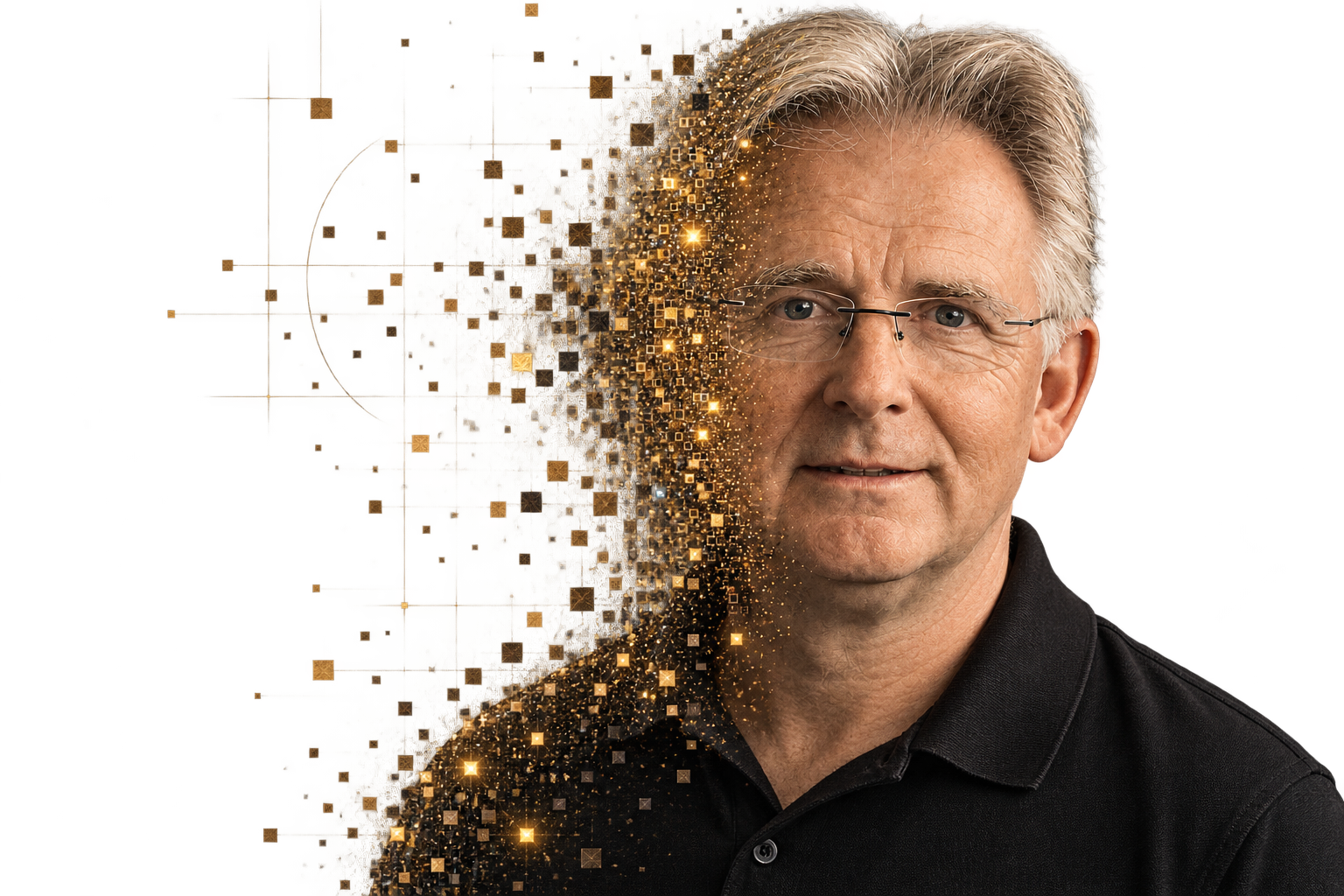
From research
to artificial intelligence
The route to Autobiography of an Artificial Mind: A novel was not a straight one. But some of the questions at its heart have been around for a very long time.
Neurobiology & animal welfare
University of Sussex; PhD from Aberdeen; early research into animal welfare and the difficult problem of understanding other minds.
Design & higher education
Director of the Design Research Centre at Brunel University, then Professor and Dean at what is now Ravensbourne University.
Digital & strategy
Independent consultancy with global brands, innovative technology businesses, universities and charities; increasingly focused on strategy.
Strategy meets AI
Strategy work increasingly moving into AI, culminating in AI-Augmented Decisions — and running alongside the creation of this novel.
After my first degree in neurobiology from the University of Sussex, my early research career, and PhD from the University of Aberdeen, was in animal welfare, a topic with questions of ‘animal minds’ at its heart. I then spent ten years as an academic, firstly as Director of the Design Research Centre at Brunel University (hence my book on Product Design in 1995) and then Professor and Dean at what is now Ravensbourne University.
Since 2001 I have been an independent consultant, working with many of the world’s biggest brands, including Cisco, HSBC, Google, Lilly and Sony PlayStation, and some of London’s most innovative tech start-ups, including Ometria, as well as universities and charities. For the last ten years my consultancy work has focused on strategy (hence The Strategy Manual, published in 2020). Latterly this strategy work has moved increasingly into AI (hence AI-Augmented Decisions, published in 2025).
A tale of
three novels
The published novel was not my first attempt at fiction. Two earlier projects did something more important than reach a bookshelf: they taught me how much I still had to learn.
The animal-welfare novel
My journey to novel-writing began a great many years ago, during my research career. I had this idea that the plight of farm animals under intensive farming conditions could best be illustrated through fiction.
As a research scientist, always aware of the need to avoid anthropomorphising animals, this could be no Watership Down. No dialogue would pass between the snouts and beaks of the animals in my novel. Not a great start for a debut novel.
I did, however, persevere through a 50,000-word first draft, which got me through the very early stages of learning my craft as a novelist.
The science thriller
Next, I embarked on a science thriller. People around the world start dropping dead with a peculiar set of symptoms and the race is on between three scientists to find out why.
One believes it is a virus, another believes it is an environmental toxin and the third thinks it is a genetic trait we have accumulated, unchecked for generations, and only now being detected and reported for the first time.
More writing, more learning about how to write, but a project ultimately overtaken by the pressures of life. This might, however, be one to dust off in a year or two.
Autobiography of an Artificial Mind: A novel
Then I started to write Autobiography of an Artificial Mind: A novel. I’m not sure I’d have even started if I’d known it would take me almost seven years to finish. But I started, I persevered and here we are, planning the countdown to publication day.
A special mention here to my sister, Lisa, who was a key factor at the start, in the middle and towards the end of the entire writing saga. Also critical were the Jericho Writers Ultimate Novel Writing Course, my wonderful tutor on that course, Helen Francis, and my amazing fellow writers at Table 52 Writers.
How the book
came to be
The history of this novel has been reconstructed in unusual detail, including the long route to the finished book and the role artificial intelligence did, and did not, play in its creation.
A Tale of Three Novels
The longer, evidence-based story of how I learned to write fiction, how the three projects evolved, and how the third eventually became the finished novel.
How much was written by AI? An interesting question.
An attempt to answer a deceptively difficult question with evidence rather than assertion: exactly how AI was used within the creative process, and what that means for authorship.
Research made
practical
Before fiction, my books grew directly out of my professional work: design, strategy and, most recently, artificial intelligence.
From my work in design research and academia.
From two decades of consultancy and strategy work.
A practical guide to combining human and artificial intelligence in decision-making.
The novel — and the questions behind it.
Autobiography of an Artificial Mind: A novel brings together fiction, consciousness, artificial intelligence and some very human questions about judgement, agency and what we owe to other minds.
Interviews, speaking, review copies and media enquiries.