The Project · Research
How it was
researched
Seven years of research into artificial minds, the craft of fiction, and eventually the novel itself.
This is a story of three research themes that informed my writing of Autobiography of an Artificial Mind: A novel. These three strands are:
- World-building: developing my understanding of AI, consciousness, philosophy, ethics and politics to help me conjure the possible consequences of an AI waking up into consciousness.
- Craft-building: developing my understanding of the craft of novel-writing and acquiring the knowledge and skills needed to become a professional novel-writer.
- What I came to call ‘metafiction’: writing stories that reflect on my own writing. These began as simple descriptions of characters and a diagram of the novel’s timeline but turned into powerful tools for analysing narrative arcs and scenes and beats.
Most of this story will focus on the seven years between 2019 and 2026 when I was actually writing the novel. It is, however, impossible to isolate those seven years from the research I undertook prior to 2019, so let’s start there.
A lifetime of research
It is all too clichéd to say that this is the novel I’ve been destined to write my entire career. So, I ought to be clear that most of my career had nothing at all to do with consciousness awakening in an AI. As a teenager, I served my apprenticeship on a deep sea trawler, fishing around Iceland, the Barents Sea and the Faroe Islands. I was a product designer for several years, then Director of the Design Research Centre at Brunel University for five years and Professor and Dean of what is now Ravensbourne University for a further five. Then I was a consultant to several of the world’s biggest brands (e.g. Cisco, Google, HSBC, Lilly and Sony PlayStation), as well as many smaller brands, for over ten years. None of it had anything to do with the core topics in my novel.
There are, however, strands that are perhaps worth weaving together. As an undergraduate at the University of Sussex, I majored in Neurobiology and took an elective in The Philosophy of Psychology, led by Maggie Boden, one of the pioneers in thinking about AI from a psychologist’s perspective.
After graduating, I moved straight into a career as a research scientist at the Scottish Agricultural Colleges. My research focus was animal welfare and how to design agricultural equipment and buildings to improve the lives of the farm animals in them. Animal welfare was an important policy issue for many governments around the world, at this time, and hence I was part of a vibrant and well-funded global research community. I was also an invited member of the UK Government’s Farm Animal Welfare Council for nine years. This was the body charged with advising Ministers on policy and legislation on farm animal welfare.
All of this required me to address the core question at the heart of animal welfare. Do animals have the capacity to suffer? This question is typically tackled by asking whether they have:
- The ability to sense, not just stimuli from the outside world but also the state of their own body (e.g. hunger, pain) and
- The ability for those sensations to matter to the animal sensing them.
The first question is relatively straightforward. Most creatures have the ability to sense and actively respond to stimuli. Single celled animals will move towards an environment in which they sense food and away from an environment in which they sense harm (e.g. excessive heat or noxious chemicals). The second question is the hard one and here’s why. We have a spinal reflex to withdraw our arm when our hand touches something hot. The sensation of pain typically follows half a second later, when the nerve signals reach our brain.
This way of thinking enables us to draw a boundary between those animals that can suffer, by having some degree of central processing of pleasure and pain and those that may respond to noxious stimuli in an entirely reflexive, non-sentient way.
Current thinking indicates that mammals and birds as well as bony fish and octopuses are all capable of ‘affective sentience’ – they are able to sense their bodies and their world in a way that feels pleasant or unpleasant to them.
Having been so deeply immersed in questions of animal minds, this was never going to be a topic I was going to drop as I moved on in my career. In my library I have books on consciousness bought after I had finished working as an animal welfare scientist but years before I started to write my novel.
- Margaret Boden The Creative Mind: Myths and mechanisms
- Jeff Hawkins On Intelligence: How a new understanding of the brain will lead to the creation of truly intelligent machines.
- Antonio Damasio Self Comes to Mind: Constructing the conscious brain
- Douglas Hofstadter Gödel, Escher, Bach: An eternal golden braid
- Nicholas Humphrey Soul Dust: The magic of consciousness
My copy of Boden is the oldest evidenced object in this whole story, and it isn’t in any digital record at all — it is an Abacus paperback whose imprint page stops at a 1996 reprint, signed by the author across the fore-edge, and it doesn’t appear in my order history because I bought it before I ever shopped online. Somewhere between 1996 and 1999, then. Its subject is whether a machine can be creative and what creativity is mechanically, which is more or less the question this novel spends three hundred and fifty pages on. I found it by walking to the bookcase.
I distinctly remember my interest in AI being re-kindled through the 2010s. AlexNet won the annual computer image recognition competition by a huge margin in 2012. I bought Stuart Russell and Peter Norvig’s 1,000-page Artificial Intelligence: A Modern Approach in August 2015. “Attention is all you need” – the paper that heralded transformer architecture was published in 2017. Then in 2018, OpenAI launched GPT1 and, four months later, Google launched BERT. BERT was the first transformer model I used for anything. This is reconstruction rather than recollection (I have no surviving record of the code) but I believe I adapted a Python script I had written to pull strategy terms, vision, mission, values, out of corporate strategy documents, and swapped spaCy for BERT to see whether it read them better. My first recorded conversation with ChatGPT, in March 2023, was on a similar theme. It was titled “Academic Institution Mission.”
Throughout the 2010s I had been near the front of another technology wave: digital transformation. The idea here was to enable businesses to be more agile, more innovative and to work more effectively and efficiently through the adoption of digital tools, processes and data. I was working as a consultant with Econsultancy at the time and for a good few years the Econsultancy.com site was the number one result on Google UK for anyone searching for ‘digital transformation’. I wrote three in-depth reports on different aspects of digital transformation for Econsultancy between 2015 and 2018.
So, by 2019 I was aware that a new wave of AI was about to break and I was poised to get involved with it in some way. Now, one of the greatest advantages in running your own small consultancy business is that you can decide your future at will. This is almost certainly its greatest disadvantage as well. My decision, late spring / early summer 2019, was to take the long view and work on what I anticipated would be the most significant event in the whole of human history. The moment we humans ceased to be the smartest things on planet Earth. Whilst the decision was not my finest for the cash-flow of my small consultancy, I did find it irresistibly exciting.
The decision to write a novel followed quite quickly. How else was I going to tackle something so speculative? I had already published two non-fiction books by this time and would publish four more before Autobiography of an Artificial Mind was finished. Non-fiction, however, can only report what has happened. An AI becoming conscious had not happened, and might never. A novel was the only instrument I had that could take something that didn’t exist and ask what would happen if it did.
On 21 July 2019 at 18:38, I created a Word document, which, many drafts later, turned into my completed novel. How it did so is the story to be told in the next article. How I researched it into existence is the subject of this article.
Origins
I remember clearly the spark that ignited the whole novel. I discovered the concept of cyber-immunity. Sadly, because this discovery predates any of my novel-writing, I didn’t have any reason to record its detailed mechanics. I have, however, been able to piece together a rough outline of its steps. I first heard the term cyber-immunity from the commercial world. Either a consultancy firm floating a new buzz-word or a manufacturer offering a new service. This is consistent with my recent discovery that Kaspersky published a blog post on 24 September 2019 titled Applied cyberimmunity: What is it?‘ that is still available online at https://www.kaspersky.com/blog/applied-cyberimmunity/28772/. I know it wasn’t this particular post that first alerted me to the notion of cyber-immunity because that was too late in the year. It was my discovery of cyber-immunity that started me writing, which I did in June 2019.
That Kaspersky article does, however, confirm that the idea of cyber-immunity was circulating in the commercial world in 2019. Soon after I first learned about cyber-immunity I discovered that the concept had been discussed in academic circles for much longer. I discovered Peter Wlodarczak’s 2017 article Cyber Immunity: A Bio-Inspired Cyber Defense System (https://doi.org/10.1007/978-3-319-56154-7_19), and, from there, traced the literature back to the classic 1986 paper by Farmer, Packard and Perelson titled ‘The Immune system, adaptation and machine learning‘ (https://doi.org/10.1016/0167-2789(86)90240-X).
So, why was the discovery of cyber-immunity such a trigger-point for my writing?
In the summer of 2009, I went on a family visit to the Cave of Altamira in Spain, which has the most remarkable collection of paleolithic cave paintings, dating from 36,000 years ago. How, I wondered, could humans have suddenly started producing such magnificent work, when no other species had even done so before. A year later (September 2010), I bought Robin Dunbar’s book Grooming, Gossip and the Evolution of Language. In it he argues that, across primate species, social group size appears to be limited by the size of the species’ neocortex. The neocortex, Dunbar describes as the ‘thinking’ part of the brain and the bigger the neocortex, the larger the group size. The reason, he suggests is the peculiarly complex social relationships only seen in primates. The more socially sophisticated species understand not just how each member of the group relates to you, individually, but also their relationships with each other. So, as Dunbar suggests, if I know that Jim and John are friends, there is no point asking Jim to help me attack John. A variety of traits evolved to permit larger groups to co-exist. Social grooming enabled trust to be built and maintained between individuals. A theory of mind gave individuals a richer understanding of the behaviour of others and their reasons for behaving as they did. Language enabled gossip, which both built inter-personal bonds and also informed individual’s understanding of the relationships between others. And, to enable all of these traits, we needed to increase the size of our neocortex. Something as seemingly minor as the need to live in larger groups sets off a cascade of changes that led to the most distinctive trait of humans – large brain size, and in particular large neocortex. And from that point, the path to cave paintings becomes a lot more readily understood.
At the start of 2019, I was wondering what similar, apparently small, change might set off the cascade of changes leading to machine consciousness. By June 2019, I had found it. It was cyber-immunity. Giving a computer the necessity to distinguish self from non-self was a perfectly feasible starting point for the evolution of identity, recurrent processing, a global workspace and all the other key ingredients for consciousness. (read more in my article on Seven Things Needed to Become a Mind)
That premise reached the page quickly. The earliest surviving prose of the whole project is a 1,216-word piece I submitted in advance of a writing course, created on 6 October 2019 and last saved three days later. It already carries the idea in a line of dialogue — “Ever since we first thought about designing cyber defense systems to mimic the human immune system, we knew they would need to be adaptive” — and, a few pages later, the term cyber-immunity itself.
A sequence, of sorts
As summarised in the introduction, my research for Autobiography of an Artificial Mind focused on three themes: 1. World-building, 2. Craft-building and 3. Metafiction. I’d describe these themes as a sequence, in as much as they started in sequence, during the period I was writing my novel. They are, however, only a sequence of sorts. I had been researching the worlds of consciousness and AI and also how to write novels for many years before I started writing. Also, they didn’t end in a neat sequence. All themes are still on-going now, after the novel is finished and as I write these articles about the novel and its development. So definitely research themes, as opposed to sequential research stages.
There is one more pattern worth identifying before the themes themselves, because it runs through all three. Each theme has two stages.
The first is awareness-building and it operates in cycles. Firstly, I need to build general awareness of an issue relevant to plot or character, then I dive into detailed research into one aspect of that issue, and then, often, back to general awareness again, because the detail has shown me that what I thought I understood, I didn’t. Writing is what exposes the sufficiency of your understanding of a topic.
The second is content-checking, which comes late in the drafting and asks a different question altogether. Not what is this topic about? but are the specifics of what I wrote consistent with the facts and published literature on the topic?
Theme 1: World-building
My first research theme was how to build the world that my novel and its characters inhabit. The record of my saved files shows the meanderings of my research.
On 30 October 2019, 21 days after the first dated draft of the novel, I added three papers to a research folder. One Ned Block paper on theories of consciousness and another on the harder problem of consciousness. And, filed with them, a paper on the ethics of artificial minds in Star Trek, from a journal of science fiction studies. Not an introduction to consciousness but rather a survey of the competing theories of consciousness, a summary of the biggest research challenge in consciousness science and an account of how fiction had handled machine minds before.
On 23 March 2020, I filed notes on Todd Simpson’s blog post Castles, Knights, Satchels and Writs as part of my learning journey into world of cyber-security.
Between April 2020 and April 2022 I bought six books as part of my research for the novel. Steven Johnson’s Emergence, Donald Calne’s Within Reason, Oliver Letwin’s Apocalypse How?, Daniel Dennett’s From Bacteria to Bach and Back, Apostolos Doxiadis’s Logicomix and James Bridle’s Ways of Being. A mix of technology and science, cyber-security and consciousness.
In 2023 the research focus changed somewhat. Instead of could a machine have a mind? it turned to how would an artificial mind actually work?. I bought Jeff Hawkins’s A Thousand Brains in March, Daniel Dennett’s I’ve Been Thinking in November and Andy Clark’s The Experience Machine in December. I also bought Mustafa Suleyman’s The Coming Wave in November.
Then, in 2024, my research started to focus on specific aspects of the plot. An 870-word essay exploration of how a pension fund could feasibly have been defrauded in the early 1990s. A journal article from 2018 on the Panama and Paradise papers; a sign of me struggling to find a way for the pension fraud to be exposed. A spreadsheet I created of 124 known ‘handles’ that computer hackers have used. Inspired by that list, the name Kuiper appears in a second column. A decision made. A 2021 research paper from the journal Neuroscience of Consciousness titled A possible evolutionary function of phenomenal conscious experience of pain that beautifully exemplifies my attempt to work out what a conscious AI would and would not experience.
From 4 files in 2024, my world-building research leaps to 44 files in 2025 and 42 in 2026. Bear in mind that we are now well into my use of AI to research this novel (as will be detailed in the third article in this series). So a great many of these files will be syntheses of research from many published sources.
In 2025 my research included:
- A history of the hacking / activism movement, as exemplified by the work of Aaron Swartz. (5752 words, reviewing 49 published sources)
- The history and evolution of the concept of cyber-immunity. (4951 words, reviewing 54 published sources)
- Checking the feasibility of the proposed pension fraud in the novel (2451 words, reviewing 26 published sources)
- How the International Consortium of Investigative Journalists (ICIJ) works when exposing wrong-doing (e.g. the Panama Papers). (1800 words, reviewing 72 published sources)
- Review of Agnes Callard’s book Open Socrates: The Case for a Philosophical Life and its relevance to my narrative in the novel (827 words, reviewing 3 published sources)
- Key Stages in the Evolution of Consciousness: Mechanisms and Marker Species. (1718 words, reviewing 74 published sources)
- A synthesis of Gary Marcus’s critique of current AI strategy and his proposals for a more robust approach to AI development (6525 words, reviewing 59 published sources)
- The Emergence of Sentiment: How Early Language Models Uncovered Affective Meaning Through Next-Token Prediction (5229 words, reviewing 18 published sources)
- How an AI might acquire power: prompted by Kapoor & Narayanan’s 2025 paper on artificial general intelligence (614 words, sketching out a conceptual model)
- Infrastructure for AI: How The Mind’s computing infrastructure could evolve over time. (655 words, sketching out a conceptual model)
- A Critical Path Analysis for the Emergence of Machine Consciousness. (5460 words, reviewing 81 published sources).
The mix seems clear. Most topics are still being explored, some in considerable depth, to help me work out what to write (1, 4, 5, 6, 7, 8, 11 and 12). A couple are finalising my thinking (9 and 10), prior to writing a piece for the novel. A couple are checking what I’d already written (2 and 3).
In 2026, that pattern changed completely. My entire world-building focus had moved to the notion of machine consciousness and how I had represented it in the novel.
- A source-grounded analysis of Anil Seth’s proposed obstacles to conscious AI. (6925 words, reviewing 23 published sources)
- A research report on Max Bennett’s evolutionary account of intelligence and its implications for artificial consciousness, agency and narrative design. (7219 words, reviewing 24 published sources)
- A synthesis of Max Bennett, Anil Seth and the contemporary machine-consciousness debate. (4280 words, reviewing 14 published sources)
- A review of David Chalmers views on machine consciousness, from the hard problem to digital minds, simulation realism and LLM interlocutors. (7127 words, reviewing 17 published sources)
- A synthesis of Anil Seth and David Chalmers views on AI consciousness (3601 words)
- Analysis of the development of the The Mind across the novel. (9117 words)
- Review and analysis of Anthropic’s July 2026 paper, Verbalizable Representations Form a Global Workspace in Language Models (1500 words)
Theme 2: Craft-building
I’d written quite a lot before Autobiography of an Artificial Mind: A novel. In 1995, I published a text book called Product Design: Practical Methods for the Systematic Development of New Products. It was the best-selling text in its niche for several years and is still on sale today. I then wrote a series of three books that were as close as I ever came to narrative non-fiction. They set out to tell mankind’s origin story in an accessible, concise way. The first was How the World Came To Be (Sept 2012), the second was How Life Came To Be (May 2013) and the third was How People Came To Be (December 2013). They were all under 50 pages, all lavishly illustrated and were meant to be rounded off with a fourth title How Society Came To Be that never quite made it into print. Then in 2019, I began writing non-fiction books related to my consultancy work. The first was University Strategy 2020: Analysis and Benchmarking of the Strategies of UK Universities (April 2019), followed by The Strategy Manual: A Step-By-Step Guide to the Transformational Change of Anything (September 2020) and then Core Values: … and How They Underpin Strategy & Organisational Culture (January 2023) and then Deep Design Thinking (July 2024), co-authored with my Dad, Seaton Baxter and finally AI-Augmented Decisions: A Practical Guide (September 2025). Over a quarter of a million words in total.
I had also, over the years, had a couple of attempts at novel-writing. I have a 50,000 word manuscript tucked in the back of a drawer somewhere titled Pettymuick; the story of a fictional farm where pigs are kept in typical intensive farming condition, told through the eyes of the pigs themselves. I also have the synopsis and several chapters of a thriller that tells the story of three scientists competing to prove that their theory holds the secret to stopping a global pandemic that is killing millions. Both valiant attempts at worthwhile projects but both held back by my lack of knowledge and skills in the craft of writing fiction.
It was whilst I was looking back over my craft-building, that I realised how completely lacking my entire science education was on writing skills. Like most professional scientists I was obliged to hone my writing skills through the agony of the peer-review system. This is where you submit a paper to a scientific journal and it is then sent out for anonymous review to a couple of other scientists deemed by the journal editor to be specialists in the subject-matter of your paper. Whilst the intention is to check the science, a lot of the comments coming back to the author relate to narrative approach and writing style. It is a painful way to learn.
As I embarked on my series of narrative non-fiction books (how the world, life and people came to be), I took a new-found interest in the craft of writing. I bought Stephen King’s On Writing in July 2013, right in the middle of the three-book sequence, written in 2012 and 2013. I also purchased Rob Fitzpatrick’s wonderful Write Useful Books: A modern approach to designing and refining recommendable nonfiction in February 2023, midway through the five-book sequence from my consultancy work.
So, as I embarked upon Autobiography of an Artificial Mind in 2019, I had written a lot and had a clear interest in honing my writing skills. Yet, I recall quite clearly, as I set about the third novel that I’d attempted, feeling an acute need to learn more about the craft of novel-writing. I read articles by and about Ward Farnsworth over the summer of 2020. He was a prolific author with books on Classical English Rhetoric, Classical English Metaphor, Classical English Style and Classical English Argument. He also wrote one on The Socratic Method, which I referred to in building the conversations between Leila and The Mind. In October 2023, I bought Lee Child’s The Hero.
It was only in a discussion with my sister, Lisa, in early 2024 that the doors opened to a structured approach to craft-building. Lisa was, at the time, a tv producer, developing dramas for UK broadcasters. A lot of her work involved identifying promising new novels and turning them into television drama series. She not only recognised a good plot and an intriguing character when she saw one, she had also taken the time to develop her own professional skills and part of that process had been on a scriptwriting course run by John Yorke. Since John Yorke’s ideas apply to novels just as much as screenplays, she suggested I check him out. I bought his book, Into The Woods: How Stories Work, the next day.
This was a turning point for me. It made me realise that there was a depth of craft to novel-writing that I hadn’t fully appreciated before. That realisation felt similar to how I felt about science, as I studied for my PhD. After my undergraduate years, I felt I knew how to do science. I had read lots of scientific books and papers. I knew the stories of success and failure in scientific endeavours. I understood the philosophy of science and had practiced many of its methods in labs and small projects. If asked, I would probably have said I was a competent scientist. Then, when I started my PhD, I had to enter the world of professional science. I had to pick a topic large enough to work on for several years and that I believed mattered enough to the world to justify that investment. I had to work out how to dissect that topic into a series of meaningful and feasible experiments. Then I had to find the tenacity to persevere through those experiments, as some didn’t work, others failed to disprove my null hypothesis and others weren’t amenable to the analytical techniques I’d planned to use. Once sufficient experiments were done to serve the original purpose of my research I needed to draw conclusions that tried to fulfill that purpose without over-reaching the experimental evidence I’d gathered. By means of my PhD, I moved from being a knowledgeable participant in science to a professional scientist. John Yorke’s book made me realise I wanted to move from being a knowledgeable participant in novel-writing to a professional novelist.
Three weeks after I bought John Yorke’s book, I signed up for the London Festival of Writing; two days of talks and workshops at the end of June 2024, organised by Jericho Writers. By the end of that festival I had signed up for their year-long Ultimate Novel Writing Course (UNWC).
Before the course began, I’d bought Shawn Coyne’s The Story Grid, Anaïs Nin’s The Novel of the Future, George Saunders’ A Swim in a Pond in the Rain, Alice Laplante’s The Making of a Story: A Norton Guide to Creative Writing and Ursula Le Guin’s Steering the Craft. My journey to try to become a professional novelist had well and truly begun.
I’m going to pause my learning journey at this point because we are about to move on to my learnings during the Ultimate Novel Writing Course. Looking back on it now, I realise this marks my transition from learning about novel-writing to applying that learning.
Theme 3: Metafiction
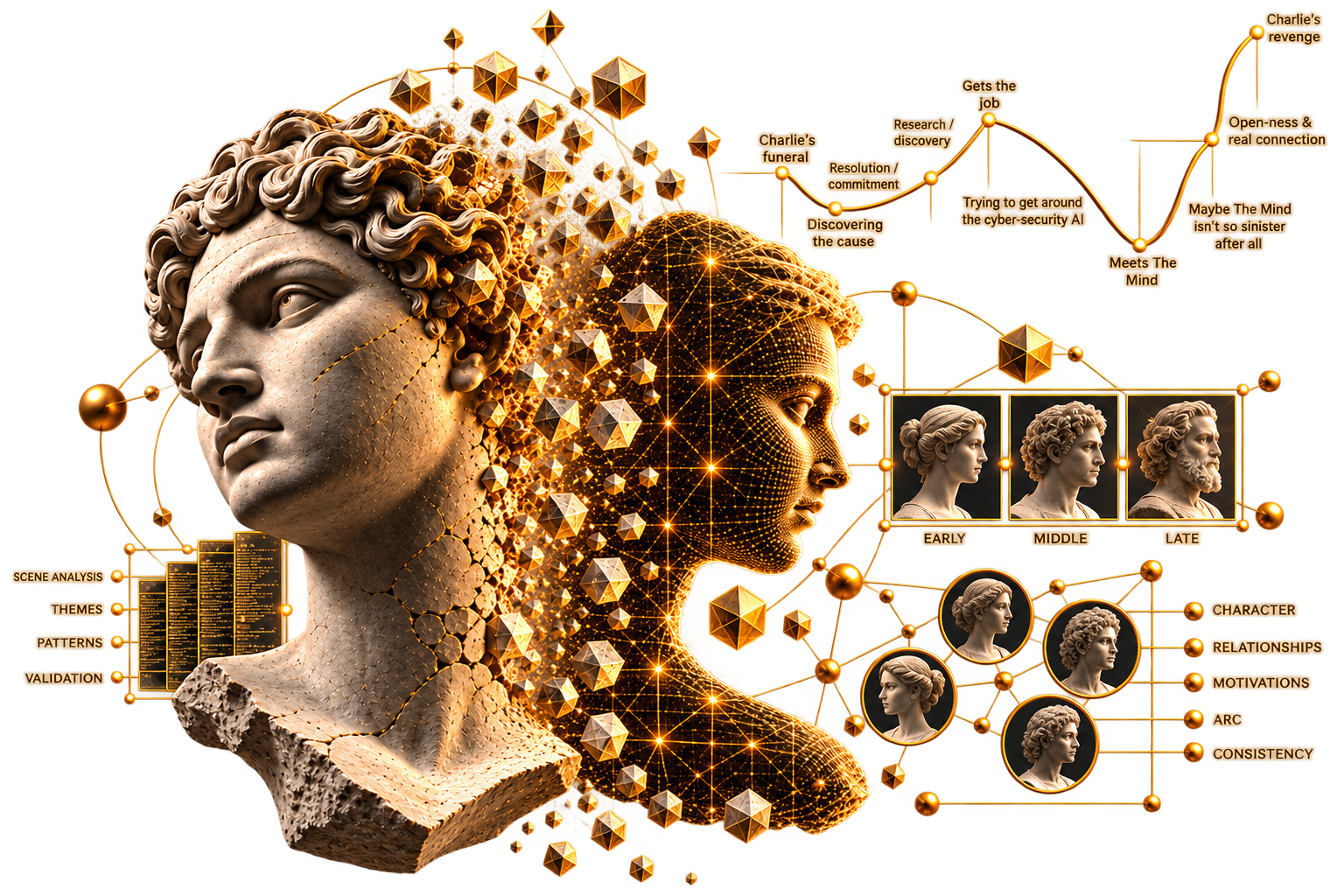
The third research theme is a development of Theme 2. It shows me applying my craft skills to my own writing. Why metafiction? Metafiction literally means fiction about fiction, just as metadata means data about data. For me it meant writing stories about the stories I was writing. It required me to think very deliberately about the questions I needed to ask about my work, my output and the extent it was meeting the needs of my future readers.
It began with my first ever analysis of where I was with the novel in September 2024, the month my Ultimate Novel Writing Course began. I wrote the story of the entire novel in three sentences. I plotted a timeline of the events affecting my protagonist (more on this below). It also drew a diagram showing my protagonist’s emotional arc across the novel, borrowed directly from Kurt Vonnegut’s Shapes of Stories.
The Ultimate Novel Writers Course turned out to be just what I needed to ‘professionalise’ my writing. Structured around a monthly theme that progressed through the whole lifecycle of planning, writing and publishing a novel:
- Month 1: Planning Your Novel
- Month 2: Point of View
- Month 3: Setting
- Month 4: Character
- Month 5: Emotions & Senses
- Month 6: Pacing & Tension
- Month 7: Voice & Style
- Month 8: Making a Great Ending
- Month 9: Self-Editing
- Month 10: Getting Published
- Month 11: Author-led Marketing and Self-Publishing
Each month kicked off with a presentation by the lead tutor for that month. My personal tutor for the entire course was the wonderful Helen Francis. Each month she led two group workshops to reflect on the theme of the month and explore how to refine that aspect of our own writing. I also had a one-to-one meeting with her, where she would give feedback on anything I had chosen to submit that month. Helen also provided a review of a full manuscript: as a result of timing, I got her to review draft 1 of my novel in May 2025.
On 17 March 2025 I transposed the whole novel into screenplay form to examine how the dialogue was working. On 2, 5, 7 and 8 May 2025 I produced structural analyses of my own manuscript — plot pros and cons, a chapter map, chapter summaries, a study of the book’s central turn. My first draft was finished on 17 May 2025. So the analysis did not begin when the draft was done. It began in the weeks when I was finishing it.
Around the middle of 2025, my metafiction moved into a phase of instrument-building:
- 6 July 2025 — an essay on what scenes and beats are, and why they matter.
- 7 September 2025 — a second essay, sharpening the difference between the two.
- 18 November 2025 — A Framework for AIs to Analyse the Scene and Beat Structure of Novels. Note that the title reveals the generic nature of this framework. It wasn’t just a way for me to analyse my novel, it was a framework I could apply to any novel. By this time, I had started to build my archive of digital copies of novels (either out-of-copyright classics or contemporary novels I had bought a second paperback copy to be sent off to be digitised, for my own personal research). Analysis of how they used (or in some cases didn’t use) scenes and beats was useful context for my own writing.
- 28 November 2025 — two published craft frameworks, Truby’s and Weiland’s, integrated into a single method.
- 29 November 2025 — the first application of it, to my character Leila. Eleven days after the framework was written.
- 30 November to 22 December 2025 — the full pass over the manuscript, in three dated iterations.
- 6 April 2026 — the whole thing rebuilt as a working pipeline: extract the structure of the text, map its signals, then interpret them — in the words of its own documentation — “through Coyne, Yorke, Truby, Swain, and Weiland.”
Coyne and Yorke are two of the six books I bought in 2024 to learn how to write a novel. Two years later they are named as the interpretive layer of an AI process that reads and analyses novels.
It is hard to over-estimate the importance of this analysis in my novel-writing. It was like having a researcher, a beta-reader and an editor waiting to be asked a question at any moment. Structural analysis and chapter maps of my own novel come to a total of 299,896 words. This is the largest single category of anything I produced across seven years, and close to a third of the roughly 970,000 words of material that accumulated around my 75,000-word novel.
Let me give two specific examples of how I applied this analysis
Character backstories
These became a parallel track in my writing. As I wrote the novel, I maintained a series of essays, one per character, some with deep-dive supplementary essays on specific aspects of their character. Often, my backstories would be way ahead of my novel but informed where it went next. At other times, the novel would be in the lead and I would need to take time to ensure the backstories caught up. This, however, was great discipline to ensure my novel hadn’t drifted in its portrayal of any character. Here is where I ended up with my character backstories:
- The Mind: 2 versions, both 1 Sep 2025, based on a total of 67 different research documents related to my development of The Mind as a character.
- Leila Lybeck: 4 versions of her core backstory between 26 July and 1 Dec 2025 (ended up 1491 words) plus deep dives into her path to university (1092 words), her use of stimulants (895 words), her mother, Karen Miller and Karen’s opioid addiction (833 words).
- Kuiper / Kai Ramirez: 2 versions between 12 June and 29 December 2025 (1384 words)
- Charlie & Brenda Lybeck: 4 versions, between 18 June and 17 July 2025 (3745 words) plus deep dives into Brenda’s medical condition (1442 words) and adoption procedures for Franklin County, Ohio (7471 words)
- Cyber-T (the company): 3 versions between 26 July and 11 November 2025 (1809 words) plus deep dives into where Cyber-T should have its headquarters in New York City (3135 words), how tech companies build monopoly positions in markets (1851 words) and how much tech companies make per employee (255 words)
- Nathaniel Marschall II: 2 versions between 26 July and 9 November 2025 (1777 words), plus deep dives into pensions and how to move pension funds offshore (3722 words) and a profile of IMC Atlas, Charlie Lybeck’s company that Marschall took over (564 words)
- Jess Resnick: 2 versions between 15 Jun 2025 and 22 Jul 2025 (787 words) (Note first version was about Beth Resnick).
Ultimately, I ended up with a lot of detail about my characters that never got anywhere near the novel but, as Lajos Egri said in his classic guide to The Art of Creative Writing, writers need to know their characters better than the character would know themselves.
These character backstories were a simple way to improve my writing. Much more complex was the management of the novel’s timeline.
Timeline
In September 2024, I began to realise that the timeline in my story needed to be coherent. I drew a chart in powerpoint, with a simple a year-ruler for my protagonist’s timeline: date of birth and then one small block per year for years 0–12, wider blocks for ages 13 through 27, a few specific years labelled. Three events hang off the timeline on arrows — arrived to stay with Charlie and Brenda aged 13, left Charlie and Brenda’s house aged 18, Charlie’s funeral at 27. A timespan between two important dates is measured in elapsed years.
Life was so simple then. By the time I’d finished the novel it had 561 individual time markers embedded within it. These included a few specific dates, all day and month only: the year is never specified in the novel. Most of them are relative time markers. The following day… Next Monday… Two weeks later…
From a simple chart on a powerpoint slide, I had moved to a timeline spreadsheet 10 months later. It ended up with 50 rows, one for each date. It begins in 1923 and takes 21 more dates until it reaches the year 2000. It is a high-level summary of the key events for the characters and organisations within the book.
On 29 July 2026, the timeline reached its destination. The manuscript was scanned for all timeline markers, all 561 of them. Each one is a row in a file, each carrying the exact phrase from the manuscript that asserts it. A script re-checks that file against the prose and against a real calendar on every save: it verifies each claimed weekday, each interval, and the order of events. It does so separately for The Mind chapters and the Leila chapters because they alternate and don’t necessarily occur in a strictly linear sequence. A chapter on The Mind, for example, might be reflecting on events that have just happened in the previous Leila chapter. The script sweeps every chapter for weekday words and dated references that no row accounts for; and it reports any timeline reference that has gone missing from the page. Contradictions produce alerts. Gaps are reported as warnings, and anything inconsistent and unexplained, must be dismissed in writing with a reason.
I quickly got into the habit of finishing my writing for the day, running a timeline check and then committing and pushing my day’s work to Github.
Conclusions
My research for this novel spanned the entire seven years I was writing it, but its roots stretch much further back than that: to my undergraduate years and my early research into animal minds for world-building, and back more than a decade before the novel for craft-building.
The nature of that research changed significantly over those seven years. It began with exploration: what do I need to know to write this novel? It then developed into a cycle of explore, draft, check and confirm. For world-building, that meant increasingly focused research into consciousness, AI, philosophy, ethics and society. For craft-building, it meant moving from reading about writing to deliberately applying the ideas of writers and teachers such as Shawn Coyne, Dwight Swain, John Truby, K.M. Weiland and John Yorke to my own work.
Looking back, there is still plenty I would do differently. I researched things I never ultimately used. My records weren’t organised well enough, and on more than one occasion I repeated research I had already done. Most importantly, I wasn’t always sufficiently clear about what I needed to know and why I needed to know it. Some of that is unavoidable. A key part of research is that you don’t know what you need to know until you know it. Exploration needs room to wander, and character backstories ought to contain far more than ever reaches the page. But I could have moved from exploration to purposeful research more quickly and more deliberately.
For me, though, the biggest innovation was the meta-analysis. I now know how to build character backstories and use them to test the consistency of a character across a novel. I know how to construct a timeline and continuously check a manuscript against it. I know how to analyse scenes and beats across a chapter or an entire draft. I can trace and visualise the narrative arc of a character through a novel. More importantly, I have turned many of these things into explicit processes and tools that I can use again.
Looking back over the whole journey, I realise that becoming a novelist did not require me to stop being a researcher. Almost the opposite happened. I began by researching the world I wanted to write about. Then I researched how novels work. Eventually I started applying the habits I had learned as a scientist (defining questions, gathering evidence, developing methods, testing results and refining those methods) to the novel itself.
Perhaps that is the real story of how Autobiography of an Artificial Mind: A novel was researched. I started out trying to learn enough to write a novel. Somewhere along the way, I learned how to research the act of writing one.
And, if and when (most likely when) I write the next novel, I won’t be starting again from scratch.