THE MAKING OF THE BOOK · AI
How was AI used?
I used AI to assist me in writing Autobiography of an Artificial Mind: A novel. I say so proudly and with what I feel is complete justification. Indeed I struggle to imagine myself ever writing anything, nowadays, without AI assistance.
A seven-year writing project · AI archive analysed through August 2026
Why use AI in the creative writing process?
Why would a novelist ever ask AI to assist in the creation of ‘their’ novel? The answer, for me, lies deep in the creative process. I have been fortunate enough to work in four creative professions: science, design, higher education teaching and consultancy. One type of question is common to all of them and lies at the heart of their creativity. It is the question that starts with ‘how else?’ Science: how else could these observations be explained? Design: how else could this product be designed? HE teaching: how else could this complex idea be made comprehensible? Consultancy: how else could this business serve its customers?
As I engaged more seriously with the craft of writing, I found myself asking more and more ‘how else’ questions. How else could I make the narrative more tense, more engaging, more satisfying? How else could my characters drive the plot forward? How else could these characters transform over the course of the novel? How else could I end this chapter so readers want to carry on to the next?
Most of the answers come from within. I suspect a key difference between more and less accomplished novelists is how well they can think of, and then answer, these questions. But, no matter how accomplished, no author can answer them all. If we could, we wouldn’t need beta readers. It is these beta readers that teach every budding novelist the lasting lesson that readers see passages quite differently from how the writer intended.
A good novelist answers the important ‘how else’ questions themselves, but can always benefit from help. Beta readers are one source of that help. A good editor is a second. And AI is undeniably a third.
Data on my use of AI
Let me start with the facts. The background statistics which we established in the first two articles in this series (How was it researched? and How was it written?) are that the published novel has 75,322 words, over 41 chapters. I started writing it in July 2019 and finished in September 2026: just over seven years. Over that period, I actually wrote 179,081 words but then removed 103,759 of them. Alongside the novel I produced about 970,000 words of other writing: analysis, essays, character backstories, course work, notebooks and marketing. The largest share, about 300,000 words of structural analysis, was mostly commissioned from AI.
My first recorded conversation with AI in my archive is on 18 March 2023. It was about my consultancy work and had nothing to do with my novel. The first conversation about the novel was on 27 November 2023, four years and four months after I started writing it. I asked for suggestions for a fictional company name. I liked one of them, Lumir, and used it for about a week then dropped it. The company at the heart of the novel went through several names before I chose Cyber-T myself, 11 months later and with no AI assistance. This was after I discovered that T-cells were the mechanism of biological immunity that a successful cyber-immunity company would need to mimic.
The first time any draft of the novel entered an AI conversation was on 1 December 2024. I attached an extract of the novel that I wanted to share with the tutor group on my year-long novel-writing course and asked AI to summarise each chapter.
So, we have an archive of AI conversations about the novel that begins in November 2023 and ends in mid-August 2026. The archive holds 258 recorded conversations with AI: 151 with Claude, 53 with ChatGPT and 54 with Gemini. An additional 13 sessions with NotebookLM and Claude Code left no transcript. Within those 258 recorded conversations we exchanged 3,334 turns. I typed 84,347 words in 1,659 prompts. I also made 282 uploads, amounting to 2,710,166 words. 83% of those words were drafts of my own manuscript; the rest were notes, briefs, research papers and three published novels. 39 of the uploads were images. The AIs sent back 1,451,706 words in their 1,675 replies to my prompts. For every word I typed as a prompt, I got 17.2 words back. For every word I gave, either as a prompt or as an attachment, I got just over half a word back. The total number of words that passed through these conversations with AI was 4,246,219.
A note on incomplete records. Despite my many efforts to retain a complete record of my interactions with AI, my archive is incomplete, and the gaps matter for any attempt to measure what AI contributed to my novel.
The worst is Gemini. Between May 2025 and August 2026 I had 54 conversations with it about the novel, 154 turns in all, many of them in May 2025 as I finished the first draft of my novel. Unlike Claude and ChatGPT, Gemini offers no conversation export, only an activity log. That log keeps my prompts, in full, but not Gemini’s replies. When I manually recovered 23 conversations in full and compared them with the log, it held only 45% of what Gemini had written, with no sign of which replies had been cut. As an illustrative example, on 9 May 2025 I asked Gemini to “produce a summary of my entire draft novel attached and give me scene descriptions within each chapter”. I know from my own copy of its output that it wrote 5,340 words; the log kept 67.
Claude and ChatGPT keep their conversations, but not everything I gave them. Of the documents I uploaded to them, more than a third survive in the exports as a filename only. Gemini records every upload that way. Some tools keep nothing at all: my 13 sessions in NotebookLM and Claude Code left no transcripts, and neither did the final weeks of work I did in Cowork, much of it on book marketing materials like this article. Two of those Cowork sessions, in late August 2026, did work on the manuscript itself: Claude and I worked through twelve changes, all using words of mine, and checked a fix to Chapter 16. After that, only my own final revisions and the copy-edit remained.
I have filled what gaps I could. Where I recovered a Gemini conversation, I used the full text. Where only a filename survived, I found my own dated copy; most were drafts of the novel, handed over again and again. Of the 2.7 million words I uploaded, I could measure 94% this way. The remaining gaps cut both ways: missing replies and transcripts could hide words AI wrote, while missing uploads can make my own words look as if AI wrote them first. By far the largest gap in the record was my own material, not the AI’s.
The work done with AI
Over four million words of interaction with AI is a lot. What type of work was I doing in all these interactions? Two trends are evident. The first is the focus of my prompting over time: what were my prompts asking the AI to do? The second is more narrowly focused: how did AI help me with the actual writing?
What I asked AI to do, and how it changed over time
Whilst I was writing the novel for just over seven years, I only used AI for the latter two years and nine months of that time. Within that period the intensity of my AI use increased significantly. Between November 2023 and August 2025, I used AI on average once every nine days, entering an average of 6 prompts on each of those days. Then, between September 2025 and June 2026, I used AI once every four days and averaged 8 prompts a day. Then, in the last two months (July and August 2026), I used AI on most days and entered 25 prompts a day.
Over the entire time I was using AI, my prompts changed focus significantly.
PROMPT MIX · NOV 2023–AUG 2026
Share of my prompts about Autobiography of an Artificial Mind: A novel in each period. 1,659 prompts across Claude, ChatGPT and Gemini; percentages are approximate, from a classified sample of 357.
Each period’s bar is 100% of the prompts in that period; the prompt counts show how activity grew, with 667 prompts in July and August 2026 alone. Sample margins are roughly ±5–10 points per category per period, so read differences under ten points as noise.
The prompts moved from research (2024), to working out the story (first half of 2025), to drafting (second half of 2025), to analysing the manuscript (first half of 2026). They ended in a two-month burst of editing and checking, which alone accounts for about 40% of all prompts.
How AI helped me write
The best way to explain how AI helped me write is to think about a continuum from the simplest, most mundane tasks through to the most creative ‘writerly’ tasks.
- From corrections to house style. Although I rarely asked for it, AI caught a great many spelling and punctuation errors in my writing, a lot of them due to my fast but not very accurate typing. Quite early on in my AI interactions, I noticed two persistent habits in most of what was written by AI: the separation of clauses with em-dashes (long dashes) and Americanised spelling. It was these that started my development of a set of house style rules. I ended up with 16 such rules: 4 covering spelling and language, 6 on punctuation and typography, 3 on The Mind’s voice and how it changed between the first and second halves of the novel, and 3 on formatting the captions in the Epilogue. Towards the end of my editing process, AI was checking for all of these house rules whenever I gave it any draft material.
- Requests for a single word or phrase. My very first interaction with AI for the novel, in November 2023, falls into this category. I wanted suggestions for company names ending in ‘ir’, after finding myself intrigued by the name Palantir, the controversial firm co-founded by Peter Thiel in 2003. In December 2025 I made similar requests for possible names of Cyber-T’s support programme for small businesses and charities (ending up with the ‘Public Resilience Program’) and for a small company in that programme (ending up with HarborLight Community Media). Then in August 2026, I went back and forth many times to find the name of a loans company, featured only once as a throwaway comment in dialogue between Leila and Kuiper (ending up with ParkLine Loans). I also asked for job titles or screen ‘handles’ a few times. Leila’s job title came out of one such conversation, in October 2024 (Lead Data Engineer), as did Ayesha’s in November 2025 (AI Architect). On many occasions I used AI when I was struggling to find the right word. In July 2024, I asked for a list of words describing the rage that one of my characters was feeling. In October 2024, I asked for “a list of human feelings in contrasting pairs like ‘delighted or disgusted’”, with alliteration if possible. And in July 2026, while checking a chapter, Claude flagged The Mind saying “That’s a big ask” as too colloquially British for The Mind’s voice. It offered the obvious but simple alternative, “That is a great deal to ask.”
- I asked for analysis, I got suggested copy. Much of the time, when I asked for analysis, I got analysis. For example, on 30 July 2026, I wanted to make sure that The Mind addressing Leila by name for the first time in Chapter 34 was a big moment. I therefore had to find all the previous times The Mind had addressed Leila by name in dialogue and get rid of them. This wasn’t as simple as searching for Leila’s name, because The Mind refers to Leila in its thoughts on many occasions and that was fine. AI found the lines in dialogue quickly, and I removed them. But sometimes analysis came back with a phrase I kept. On 21 July 2026 I asked Claude what it thought of my draft of a passage in Chapter 39, and whether unqualified stillness was the right state for something as powerful as The Mind. In its commentary it said The Mind now grows “because it’s free to, not because anything is at its back”. That became The Mind’s own line: “We do it because we are free to, not because anything is at our back.” In October 2025, I asked AI to give me the narrative, in bullet points, for a missing chunk of a chapter. I had tightly specified what I wanted and what came before and after this missing piece, and some of the bullet points I got back were so good that I incorporated the wording, with a few editorial tweaks, directly into the novel. One of these was “Consciousness wasn’t separate from integration. It was the integration” in Chapter 15.
- I asked for a draft. This is bound to be my most controversial use of AI. So, I want to explain why in some detail and also to explain where my boundaries as a novelist lay. The first thing to say is that it took some time to persuade myself that asking AI to draft anything was okay. I took my first step in February 2025 (remember, I started using AI for my novel in November 2023, fifteen months earlier). My prompt said: “Here is where I’ve got to with the first conversation between Leila and The Mind. How do you think it might continue?” I got some great suggestions in return. A month later I specified a scene I was struggling to write and asked for several versions of how that scene might be written. I went back and forth with the AI over several days until I had enough ideas to write the scene myself. In September 2025, I crossed the Rubicon: for the first time I explicitly asked it to redraft my own prose. I said “can you suggest a re-draft of the final paragraph…” From that moment on, I asked for drafts of paragraphs, beats, scenes and even whole chapters of my novel more frequently. Across all 1,659 prompts I typed into AI platforms, roughly 90, about one in twenty, asked for draft prose. This raises three important questions. What came back from those requests? How good was it? And how much of it ended up in the finished novel? These questions are addressed in my analysis below.
My process for using AI
I had one key rule in all my interactions with AI. I wouldn’t let it write anything directly into the draft of my novel. This was the firewall that kept my novel mine. It may not sound like much but I feel it was vital both psychologically and practically. Psychologically, it enabled me to retain complete ownership of every draft. I knew that anything in the draft was put there by me. Practically, it made me pause to think, if I ever copied something from an AI response, whether it was really good enough to paste into my novel. (The record bears this out, with three small qualifications. On 10 August 2026 Claude Code had inadvertently been given access to the folder containing the latest draft of the novel and made one uninvited change to the manuscript file, which I reverted within minutes. I once authorised it to change a single character; a curly quote, which should have been a straight quote, after I had failed to change it in my markdown editor by hand three times. And some mechanical passes of the final draft were built by Claude: they checked punctuation and, where necessary, proposed changes to that punctuation, which were approved, one at a time, by me.)
My experience over the two years and nine months of using AI to help write the novel is that text written by AI, even with extensive context-setting and highly specific instructions, is rarely good enough to simply slot into a novel. As I mentioned above, there are several widely recognised signs of AI authorship, such as the over-use of em-dashes (long dashes) and the construction of oppositional triplets (not X, nor Y but Z). I judged that these would probably annoy readers if used a lot. I also found numerous issues with the degree of abstraction in AI writing. Here’s an example from my discussions with AI about the blindfold on the Lady Justice statue (it ended up in Chapter 7, Meaning). The blindfold, AI suggested, was “so that the court can be brought in front of her and she will not see it done”. Not see it done? The large language model almost certainly knew what the ‘it’ referred to but, equally clearly, that phrase needed rewriting completely before it could go into the novel.
Another bad habit was the AI creating a new layer of abstraction to introduce a new paragraph.
“That reading held until we ran the sources back.” What reading? Which sources? Who or what ran them back?
“One question surfaced as we set the sequence down.” What question? Where did it surface? Who or what set the sequence down?
So, in general, even if I asked AI to create an entire chapter, I knew I would need to edit it so extensively that it would be more recognisably mine than recognisably AI-generated by the time it was incorporated into the novel.
The big question: how much of the final novel was written by AI
A simple way to answer that question is to ask an advanced AI detector. Pangram is one of the most highly regarded and most widely used, so I signed up, uploaded the text of my novel and here’s what came back.
PANGRAM AI DETECTOR · 16 SEPTEMBER 2026
What does the finished text look like?
The verdict is 92% human-written, 8% AI-written. Pangram is a classifier: a model trained on large amounts of human and AI writing. It scores a document in segments and reports the share of the text that reads like a machine’s, so 8% means about 8% of the novel’s text looks machine-like to it. Considering this is an Autobiography of an Artificial Mind we are talking about, if those segments are The Mind’s, I could take it as a compliment that I got The Mind’s voice so authentic that Pangram thought it had actually been written by AI.
The Pangram result is an interesting indicator, but we have much better data to answer the question with. Given that we have 75,322 words in the novel and 1,451,706 words of output from AIs, it might seem reasonable to ask how many of the words in the novel can be found in the AI output. We, however, need to be careful how we ask that question. For example, the word ‘the’ appears in the novel 3,419 times and it appears in the AI output 104,000 times. Given that I started writing the novel four years and four months before I first used AI, it is almost certain that I can lay claim to the first use of the word ‘the’ but does that give me provenance over all 3,419 uses of ‘the’ in the novel? Clearly, what this illustrates is that we cannot do this analysis on the basis of single words. What we need to work with is word patterns. In particular, we need to check word patterns that are likely to be deliberately crafted, not randomly connected. Fortunately there is a technique for that. Broder et al. (1997) developed a method for finding documents that were ‘roughly the same’ on what was, at the time, a fast-growing World Wide Web. Recognising that the distinctiveness of documents came from the sequences of words they contained, Broder et al split documents into rolling sequences of words, called ‘shingles’, and then compared the shingles between documents.
Let’s examine the idea of shingles with the opening lines of Chapter 2:
Leila left her office and locked it on the way out. Everyone referred to it as ‘the cellar’ because it was the huge windowless basement of the thirty-storey Manhattan headquarters of her employer, Cyber-T International.
Slide a window ten words wide along it, one word at a time:
- Leila left her office and locked it on the way
- left her office and locked it on the way out
- her office and locked it on the way out everyone
… and so on, to the last:
- thirty storey Manhattan headquarters of her employer Cyber T International
Each window is a shingle. They overlap like the tiles on a roof, and these opening lines have 28 of them. (My version of the process ignored capitals and punctuation, and counted ‘thirty-storey’ and ‘Cyber-T’ as two words each.) Every shingle in the final book is then tracked back, word for word, through every dated draft I kept, my notebook and every AI conversation, to see where it originated. Did it first appear in one of my dated drafts, in my notebook or in a prompt I wrote into an AI platform, in which case it would be deemed human-written? Or did it first appear in something produced by AI, in which case it would be deemed AI-written?
Broder et al used ten-word shingles too, but I kept ten because it passed my own tests. Ten words proved long enough that matches very rarely happened by chance in my tests. A passage I knew had been copied from an AI reply was caught 93% of the time. A later essay I wrote myself on the same subject, where copying was impossible, shared only 4% of its shingles by coincidence. And, as a control test to see if my AI responses could be attributed to something it couldn’t possibly have influenced, I showed that not one ten-word shingle of F. Scott Fitzgerald’s The Great Gatsby appears anywhere in the AI replies about my novel.
The history of how these opening lines of Chapter 2 were written illustrates some of the more subtle nuances of this type of analysis. The passage first appears in one of my drafts dated 15 November 2024. At that point the building had seven storeys and the company was Cyber-T Incorporated. Then the building grew to eight storeys, and in December 2025 to thirty. The company became Cyber-T International. And in August 2026 the building gained a city: Manhattan. Adding that one word broke every shingle that spans it, eight of the 28. So the published passage carries three layers of dates, like geological strata:
- shingles 1–18 go back to November 2024;
- shingles 19–20 go back to December 2025;
- shingles 21–28 go back to August 2026.
None of them appears in any AI reply, so they are all counted as author-written.
How much of the novel I wrote can be answered using shingle-analysis in four steps. Each step adds more of the evidence, and each one lowers the answer.
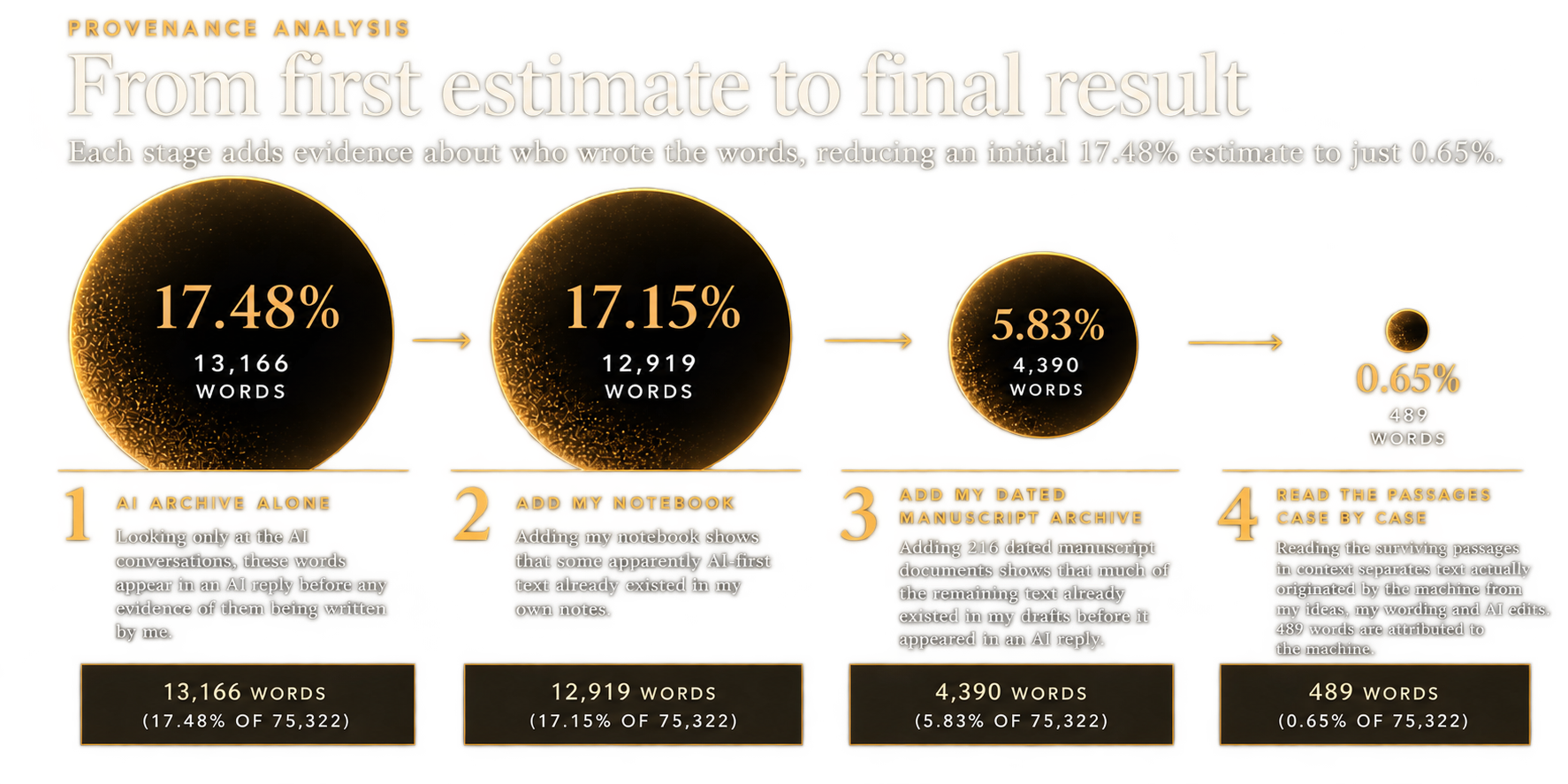
Step 1: the conversations on their own. Suppose all I had was the record of my AI conversations. A word in the novel would then count as AI-first if it sits in a ten-word shingle that turns up in an AI reply before it turns up in anything I typed in a prompt. On that basis, 13,166 words of the novel, 17.48%, appear first in a machine’s reply. That sounds like a lot, and it is badly wrong. Again and again I handed the AI my drafts, 45 times as a whole manuscript, and they quoted my sentences back to me: summarising chapters, critiquing scenes, suggesting edits. This 17.48% is based only on what was typed in prompts and what was returned, not what was attached. So, on the conversations alone, the first appearance of a sentence I wrote is often the AI repeating it back to me.
Cyber-T, the name of the company at the heart of the novel, is the neatest example. On the conversation record, the name first appears in an AI reply on 1 December 2024. That was the very first conversation to include a draft of my novel, and it looks like the machine’s coinage. But I had used the name in my own draft 45 days earlier, and in eight more drafts since. The draft I attached to that prompt mentioned Cyber-T sixteen times. The machine was reading my company name back to me.
Step 2: add my notebook. From 2023 I kept notes on the novel in a digital notebook called Logseq, a quarter of them written before I first used AI for the novel. Adding them brings the figure down only slightly, to 17.15%. The notebook holds ideas, plans and fragments rather than finished prose, so few of its ten-word runs survive into the book.
Step 3: add my dated drafts. This is the step that matters. I kept every dated draft of the manuscript, 98 drafts of the full manuscript and 118 partial drafts, making 216 documents in all. Once they are included, a shingle counts as AI-written only if it appears in an AI reply before it appears in any draft of mine. The AI-written figure falls to 4,390 words, 5.83%.
There is a choice hidden in that number. The file of every draft carries two dates: when it was created and when it was last saved. Dating each draft by its last save gives the highest AI-first figure: 5.83%. Dating by file creation drops that figure to 3.07%. The key unknown here is how much of the finally saved version was present in the first-created version. I decided to use the higher figure throughout, because it errs in favour of AI-written.
Step 4: read the passages. Even 5.83% is not “written by AI”. It means only that a machine’s reply is the earliest record we have. To find out what actually happened, the 60 largest AI-first paragraphs, two thirds of the AI-first words, were read alongside the conversations they came from. Each was given one of five verdicts:
- A. The machine’s content and the machine’s words. It supplied both the idea and the wording.
- B. My content, the machine’s phrasing. The idea was mine, usually set out in my prompt, and the machine put it into words I kept.
- C. My text, edited by the machine. I wrote it; the machine tidied or changed it.
- D. Not the machine’s at all. The match was coincidence, or the words were mine by a route discovered subsequent to the initial analysis.
- E. Can’t tell.
I ruled on 41 of the paragraphs myself. Claude ruled on the other 19 using the decision-making criteria that came out of my own rulings, and I checked three of its rulings blind; all three agreed.
By far the largest verdict was B, at 54% of the words read. The commonest pattern was me explaining what I wanted to happen and the machine offering a way of saying it that I kept. A, the machine’s own content in its own words, was 11%.
The rest of the AI-first words are in the shortest passages. I applied the same ratios to them as I derived for the longer passages. Short matches are the likeliest to be coincidence, so this, if anything, will overestimate proportion that were AI-written.
| Words | Share of the novel | |
|---|---|---|
| Written by a machine: its content and its words (A) | 489 | 0.65% |
| Plus my content in the machine’s phrasing (A + B) | 2,859 | 3.80% |
| Touched by a machine at all, including its edits to my text (A + B + C) | 3,427 | 4.55% |
From the AI-conversations alone to a reading of the AI-written passages, the answer to the question, ‘how much was written by AI?’ falls from 17.48% to 0.65%, a factor of 27.
The passages the machine wrote
Let’s look more closely at some of the longer stretches of AI-written text: a total of 319 words, in seven paragraphs. It breaks into 13 unbroken stretches, the longest 42 words. Only six stretches run to 30 words or more, 200 words in all, about a quarter of one per cent of the book.
Four of the seven paragraphs, 165 of the 319 words, date from February to April 2025, months before I first explicitly asked an AI to redraft my prose. Some came from AI producing background notes for me. In one, for example, I asked for a one-sentence definition of the Socratic method. I don’t think I even copied and pasted it into the novel. I think I rewrote it from my notes into dialogue for The Mind. It just so happened that the notes were ‘good enough’ that they ended up verbatim in the novel. I thought I had drawn the line in September 2025, when I started asking AI for drafts of various parts of the novel. The record shows AI-written words were in the book before then.
The idea of ‘good enough’ explains a lot of the AI-written words that ended up in my novel. When AI does some research or analyses a draft that I’ve uploaded, it will occasionally give a form of words that is good enough to serve my purpose as I’m drafting. These are mostly supporting passages: a bit of descriptive context, or an idea embedded in dialogue (as the Socratic example was).
However, good enough doesn’t describe all of the AI-written contributions. Some of it was a lot better than that.
Here is the story of 32 words that Claude wrote at 15.57 on Tuesday 22 April 2025 and that appear in the novel exactly as it wrote them.
At 15.47, ten minutes earlier, I was concluding a conversation with Claude about Aldous Huxley’s Brave New World. We had been discussing an exchange between John and Mustapha Mond in which John claims the right to be unhappy. At 15.51 I started a new conversation with Claude, almost certainly with my latest full draft of the novel, 19,200 words at this stage, in Claude’s project files. I began with this prompt:
“Is there an argument to be written for this novel where The Mind suggests that the rich variety of experiences that humans typically value, such as struggle and suffering, are a complete anachronism in a world of plenty?”
Claude replied with an argument in support of the idea and some suggestions on how The Mind might present it. I then typed a second prompt, which gave the conversation more context and suggested the idea of ‘what doesn’t kill you makes you stronger’. Claude’s response included this:
“A cognitive fallacy,” The Mind replied, its voice softening. “You conflate meaning with suffering because they’ve been historically correlated, not because one requires the other. It’s like believing night causes the stars.”
I was astonished. It was a lovely snippet of writing. It began assertively, in keeping with The Mind’s established voice. Then its voice softened, in keeping with the context I’d given it. Then it explained the confusion it sought to correct in its overly rational manner, and ended with the wonderful ‘night causes the stars’ simile. It was perfect and I copied and pasted it into the novel, where it remains in the published version, in Chapter 24.
This scene was the exception amidst a huge amount of drafted material that was informative and inspiring but far from usable, word for word, in a novel. Yet it is a sign of things to come. I noticed Claude’s drafting ability improve significantly over the years I was using it. I suspect by the time I finish my next novel (especially if it takes me another seven years!) beautifully written passages may be the norm from AI rather than the exception.
What this analytical method can’t see
The gaps in the record push in both directions. The uploads that survive only as a filename make me look less original than I was, because AI appears to say first what I had in fact uploaded. The missing transcripts push the other way: Gemini’s truncated replies, and my sessions in NotebookLM, Claude Code and Cowork, including the two late-August sessions that worked on the manuscript. Neither effect looks large. Taking Gemini out of the matching altogether moves the AI-written count by just 21 words.
Ten-word matching is also built to catch copying, not revision. Change three scattered words in a paragraph of ordinary length and every shingle in it breaks. So an AI-written draft I reworked is invisible to the method and counts as mine. So, what is the right analytical method? I was as diligent as I could be in finding the most appropriate method and choosing parameters to apply to this method that seemed empirically best suited to my novel. I suspect this will need in-depth academic work to produce an optimised and validated methodology for working out how much of a novel was written by AI.
The big question … answered
Where this analysis ended up feels intuitively right to me. When I ran Pangram over the final published version of my novel on 16 September 2026, it suggested 8% of my novel was AI-written. My measurements say 0.65% was written by AI, 3.80% used an AI’s phrasing and 4.55% was touched by AI. The figures don’t contradict each other, because they answer different questions. Pangram asks whether my writing looks like a machine’s. The shingles ask where each sentence came from. A detector can only judge the style of the finished text; it has no way of knowing the text’s history. Style is not provenance, and only a meticulous record can tell you who wrote what.
Conclusions
- AI worked mostly as my reader, researcher and checker. Over 4.2 million words passed through my conversations with it, and it returned 17 words for every one I typed, yet under 1% of the book is machine-written.
- Where AI did shape the prose, it was mostly my ideas in its words, which I then reworked. I cut its extra flourishes, made its abstractions concrete, and gave its dialogue the run-up real speech has. Very occasionally, as in Chapter 24, its words were good enough to keep.
- I used AI to answer “how else?” It generated alternatives; I did the choosing, and the rule that it never wrote into my manuscript kept the choices mine.
Two conclusions stand above the rest. First, a novelist can use AI extensively, including asking it for drafts, and still produce a novel that cannot meaningfully be described as written by AI. Second, proving that is hard. It depends on keeping every dated draft and every AI conversation from the very start of the writing process. Without my drafts and the provenance analysis they made possible, the conversations alone would have made AI look 27 times more of an author than it actually was.